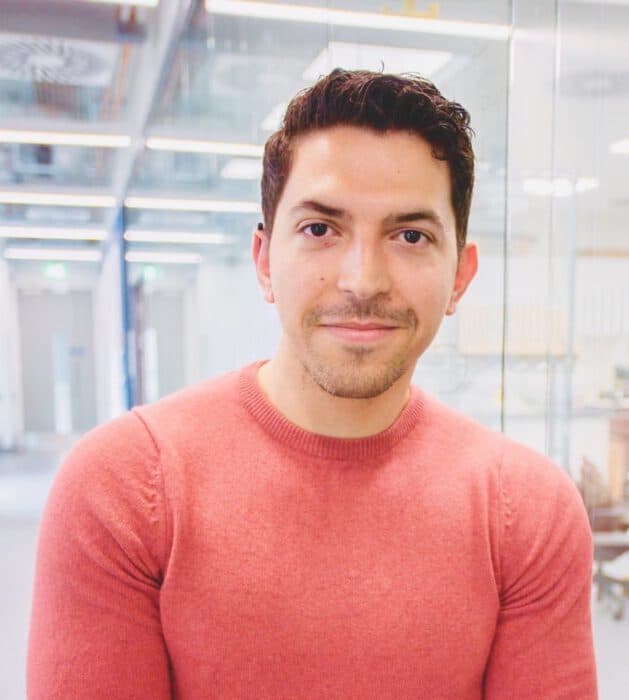
Dr Rair Macêdo he/him
Engineering light and matter: Driving discovery and innovation at the interface of materials science, photonics, and quantum technologies
Reader in Electrodynamics
James Watt School of Engineering
Research interests:
Spins and spin system, Photonics, Metamaterials, Condensed matter physics, Magnons, Electrodynamics, Optics, Magnetism, Quantum Interfaces, Quantum Technologies
Research fields:
Hybrid spin-photon systems for quantum information processing, storage and distribution; Metamaterials for designing novel electromagnetic wave propagation and unusual optical effects with application in: signal processing devices, imaging, and communication; Optical properties of natural crystals for unusual optical phenomena and wave propagation; Liquid Crystals for applications in fast optical filters
Strategic Research Areas
Why do you want to join the DiveIn community?
This CDT presents an exciting opportunity to disrupt current practices and create a community of students (and staff alike) that appreciate the importance of EDI in STEM and its transformative impact.
Personal profile:
I am fascinated by what happens when light meets matter—and by how we can engineer that interaction to do something new. My group, q-SPIn, works at the intersection of materials science, photonics and quantum technologies, combining physics, materials, computation and experiments to understand and control light–matter interactions in new ways.
Our work spans several themes. We explore how light interacts with spins and magnetic materials to create new ways of transferring, storing and manipulating information, including in quantum systems. We also investigate how materials can be designed to control the propagation of electromagnetic waves and create unusual optical behaviour. This can lead to new devices and technologies for applications ranging from sensing and imaging to signal processing, across a broad range of frequencies. These different areas do not always need to be combined: sometimes the challenge is understanding new optical or magnetic phenomena; sometimes it is about bringing these together to create something entirely new.
This makes our research naturally interdisciplinary. I currently work with academic colleagues across physics and chemistry at the University of Glasgow, as well as industry partners who currently fund 2 PhD students in my group. I also collaborate internationally, namely the Biofrontiers Centre at the University of Colorado, exploring how technologies developed from our fundamental research can be applied to imaging of biological, live tissue. These collaborations and research themes will continue to be topical and provide exciting opportunities for projects within the DiveIn CDT.
As a supervisor, I try to understand what each student wants to achieve and help them develop the confidence and skills to get there. I enjoy working alongside students for parts of their project, for example supporting a computational or experimental problems, particularly when they are tackling something difficult. Research does not always work the first time, and I think it is important that students see that their supervisor can get things wrong too. My aim is to help students become independent researchers who are comfortable asking questions, taking risks and finding their own solutions.
I am also committed to making research and engineering more equitable and inclusive. I am currently EDI Chair for the James Watt School of Engineering, EDI Champion for another CDT, and a Steering Board member of Opening up Photonics—a Technology Scotland initiative working to make the photonics sector more diverse, inclusive and accessible. I also see public engagement as an important part of this commitment: giving young people the opportunity to encounter science and engineering early can change what they believe is possible for them. I have been involved in a variety of outreach programmes, including students from disadvantaged and rural communities in South America, and in activities introducing primary school pupils to engineering and electronics in Scotland as well as supporting University of Glasgow Undergraduate students to develop and deliver a full outreach programme to secondary Schools: Introducing The Glasgow Engineering Build Off.
I started doing research very early in my academic journey, and that early experience shaped my belief that curiosity and opportunity can change the direction of a career. I hope to give students the same opportunity to explore, experiment and discover where their curiosity can take them.