
Dr Dadi Bi he/him
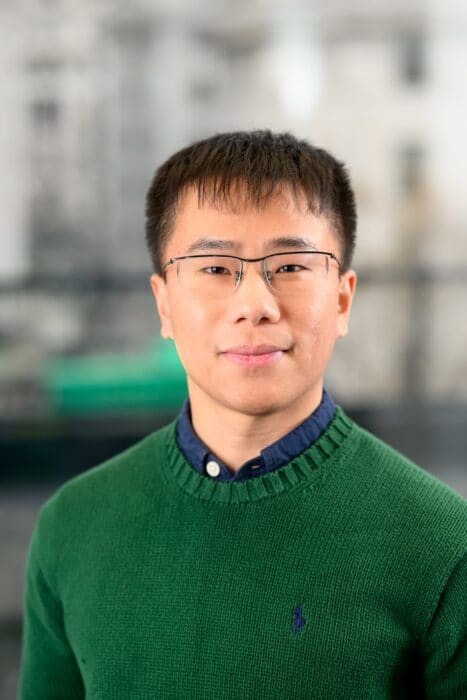
Lecturer
Strategic Research Areas
My research brings communication engineering into conversation with chemistry and biology. Moving between these disciplines has shown me how different perspectives can reveal questions and solutions that would be difficult to identify within one field. I would like to join DiveIn to build new collaborations and explore how molecular communication and chemical signal processing can contribute to challenges in healthcare, environmental sensing, and robotics.
I am particularly attracted to DiveIn’s approach to co-creating projects with doctoral researchers and colleagues from different disciplines. I would welcome the opportunity to contribute my expertise in communication theory, signal processing, and molecular transport modelling, while learning from others. Having studied and worked across China and the UK, I also value the programme’s commitment to creating an inclusive community where researchers with different backgrounds and experiences can contribute and develop.
Like humans, cells have their own “social lives”. They continually sense, receive, and interpret chemical signals, coordinating their behaviour in response. These natural interactions have inspired the field of molecular communication, which investigates how molecules can be used to transmit and process information. I am fascinated by what communication engineering can help us understand about these systems and what we can learn from them to develop new technologies.
Initially trained as a communication and electrical engineer, I apply communication and signal processing theories and tools to understand and engineer information transfer and processing in chemical and biological systems. My research combines mathematical modelling with experimental investigation. A central focus is chemical signal processing, using molecular transport and chemical reactions to transform signals, with microfluidics providing a platform for developing and testing reaction-based circuits. My broader interests include airborne molecular communication, engineered genetic circuits, and cellular signalling.
Through DiveIn, I would like to connect with researchers in chemical sensing, robotics, and mathematical modelling. Potential research directions include molecular communication networks linking biological and engineered systems, chemical sensing that helps robots interpret their surroundings, and chemical circuits that process information directly in the molecular domain. I am interested in projects where communication models help identify what can be inferred from a chemical signal and guide the design of experiments, sensors, or systems.
My approach to supervision is to combine clear guidance and constructive feedback with space for students to develop their own ideas. I aim to make it comfortable to ask questions, discuss difficulties, and challenge assumptions, particularly when working across unfamiliar disciplines.
My teaching and supervision experience spans the UK and China and includes working with students from different disciplinary backgrounds. I recognise that students enter research with different preparation, confidence, and support needs. I am committed to making expectations explicit, adapting guidance, and ensuring that everyone’s contribution is heard and valued.
My own move from electrical engineering into chemical and biological research has made me comfortable being a learner again. I hope to share that curiosity with students and support them in building confidence beyond their original discipline.