
Dr Giorgos Georgiou he/him
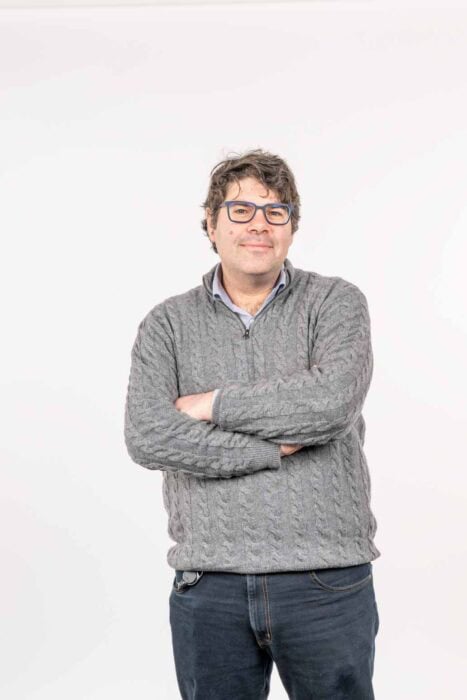
Senior Lecturer of Quantum Engineering
Strategic Research Areas
Dr Giorgos Georgiou, Associate Professor in Quantum Engineering
Building electronics and exploring exotic quantum particles for the technologies of tomorrow
My science
Put billions of electrons together in a semiconductor and cool them to near absolute zero, and they start behaving in surprising ways. They can team up with light to form polaritons, or act like new particles called anyons. They can even flow with no resistance at all, as in a superconductor. My research is about studying these collective effects and turning them into working devices.
My group, UltraQUTE, studies them at terahertz (THz) frequencies. These frequencies are too fast for conventional electronics and too slow for photonics, so we build our own tools: tiny THz chips that work at cryogenic temperatures. Our work is funded by EPSRC, the Royal Society of Edinburgh and the European Innovation Council. We work with partners in Germany, France, the Netherlands and Japan, so you’d be part of an international team.
Who I’d love to work with
You don’t need to be a physicist. Some of the most exciting questions in my field need people who think differently:
– Physicists and materials scientists who want to make and measure new devices
– Computing scientists curious about using AI to control quantum hardware
– Mathematicians who want to model how matter behaves and develop algorithms for quantum software
What your project could look like
My research already crosses physics, electronics, materials science and mathematics. Together we could shape a project in Quantum Technologies, Photonics, Advanced Materials, or Transforming Health and Healthcare. Examples include:
– Using on-chip THz light to control quantum systems
– Designing cold electronics for scalable quantum computers
– Creating affordable sensors for clinics or the environment
– Using machine learning to design devices and run experiments automatically
You’d gain hands-on skills in the cleanroom, with ultrafast lasers and cryogenics, nano-electronics design and modelling. These skills are valued in academia and in the growing quantum industry.
What I’m like as a supervisor
I’m approachable and hands-on. I offer frequent informal chats and honest feedback, and I give you growing independence so the project becomes yours. I frequently hold group meetings with my team to get quick updates, but also one-to-one meetings with PhD students. I have an interdisciplinary team and collaborate with international partners. I usually encourage my students to visit collaborators for placements.
Equity, diversity and inclusion
Great science comes from people with different backgrounds and ways of thinking. I’m committed to flexible working and to making sure every voice is heard in group meetings.
Personal
Outside the lab I enjoy cooking and gardening.