
Dr Nikela Papadopoulou she/her
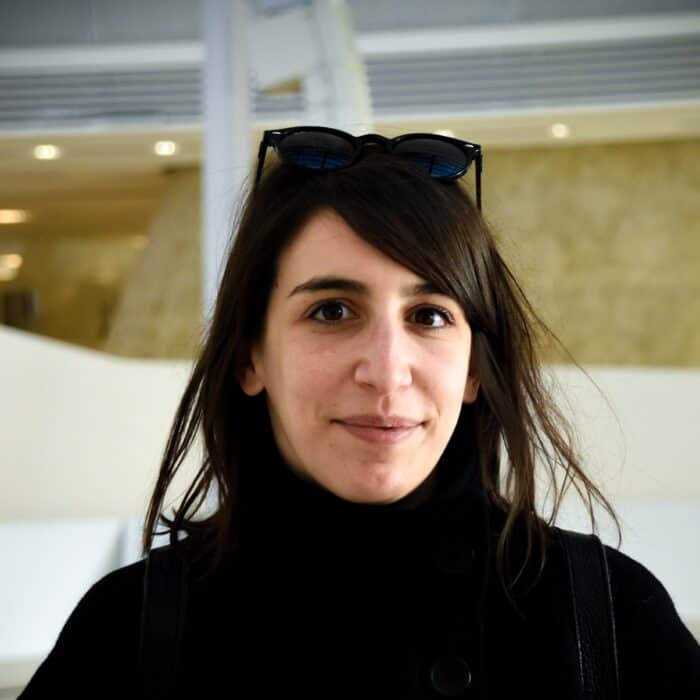
Advancing energy-efficient, scalable, and sustainable computing for scientific discovery and AI.
Lecturer in Low Carbon and Sustainable Computing
School of Computing Science
Research interests:
High-Performance Computing, Parallel and Distributed Computing, Low-Level Optimisation, Performance Modelling, Hardware–Software Co-Design, Resource Management, Energy-Efficient Computing, Carbon-Aware Computing, Scientific Computing, Sustainable AI
Research fields:
Scientific and Engineering Computing, Large-scale Modelling and Simulation, Efficient AI deployment and Scaling, Performance and Resource Efficiency of Digital Systems and Infrastructure, Energy Use and Carbon Footprint of Computing Systems, Computational Tools for Low-Carbon Systems
Strategic Research Areas
Why do you want to join the DiveIn community?
My core research focuses on low-level aspects of computing systems, where the impact becomes tangible only through the applications they enable. I believe that the DiveIn CDT is the perfect way to build collaborations in both directions: applying my expertise in performance, scalability and efficiency to computational challenges in other disciplines, and drawing on colleagues’ expertise in modelling and computational science to develop new approaches to estimating and reducing the carbon footprint of computing.
Personal profile:
I am a Lecturer in Low Carbon and Sustainable Computing. My group investigates how computing can become faster, more scalable and less environmentally costly. Our work spans low-level software optimisation, performance modelling, hardware–software co-design and resource management for scientific computing and AI.
My research connects these mechanisms with their applications: making larger scientific problems tractable, enabling reliable and efficient deployment, and reducing resource use. My previous interdisciplinary work includes scaling human migration simulations and computational workflows for precision agriculture.
Through DiveIn, I would like to collaborate with researchers whose work requires large-scale computation or careful deployment of computational tools. Potential projects could explore scaling simulations, efficient AI deployment, or trade-offs between performance, energy use and carbon emissions. I also welcome collaborations in modelling, environmental science and sustainability assessment to improve the accuracy and practicality of estimating computing’s carbon footprint.
I love working on and supervising projects where systems and application challenges inform each other. My approach combines technical guidance with increasing independence: students should learn to define research problems, critically assess evidence and decide when to pursue or reconsider a direction. I want them to complete their PhD with a clear understanding of their contribution and impact to the discipline and equipped to develop a research agenda beyond it. Students I have previously supervised have entered R&D and industry roles.
As a woman in computing systems, where women remain underrepresented, I know first-hand the barriers to entering the field and progressing within it. Working in Greece, Sweden, the USA and the UK has shown me how academic expectations vary and how much remains unspoken. These experiences inform my commitment to making expectations explicit, sharing knowledge often confined to informal networks, and providing guidance that does not assume familiarity with academic culture.
I enjoy hands-on programming and debugging, particularly when an unexpected result challenges my understanding of a system. I value theory for explaining those observations and judging whether they generalise, and knowing when to build on established work or revisit its assumptions. Asking “why” connects these practical and theoretical sides of my research; it is also what keeps me interested in problems beyond the boundaries of my own discipline.